

Data is at the core of everything we do.
Impact we measure: We use our annual M&E data to estimate the impact of our seeds on farmers’ yields and income, climate resilience, and the zinc, iron, lysine, and tryptophan content of the maize farming families and other consumers eat.
Third-party studies: We use evidence from randomized controlled trials (RCTs) to model the impact of biofortified maize on nutrition and health outcomes.
Cost-effectiveness: We combine internal impact estimates with evidence from third-party RCTs to model the cost-effectiveness of our programs. We think that if the families we serve would be better off receiving our budget as cash, we should give them the cash instead.
In-depth reviews of our data are available in our annual reports. We provide data sets upon request, and we are working to make our data, protocols, and code publicly available on the Harvard Dataverse.
IMPACT SUMMARY
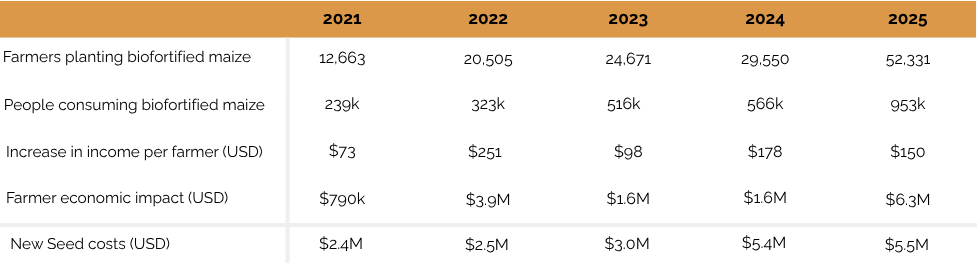
Notes: Impacts and costs in undiscounted 2026 US dollars. Total farmer economic impact counts only the share of income gains attributed to New Seed (85%), and only for farmers planting newly purchased or donated seed. Increase in income per farmer is the average gain for a farmer planting new seed, before attribution.

What we measure
Every year, our M&E collects data to quantify the agronomic performance and the economic and nutritional impact of our biofortified maize seeds compared to conventional varieties. We also collect data to understand the household, farm, and decision-making characteristics of farmers who plant our biofortified seeds; how farmers used the seed they received or purchased; how much biofortified maize was harvested, consumed, sold, and shared; climate impacts; and brand awareness. Our M&E methodology relies on two tools:
Annual Farmer Surveys
Using the contact information we collect for farmers planting biofortified seed from retailers and donation programs, we conduct annual farmer surveys that are designed to be representative of biofortified maize farming households nationwide. With data from these surveys, we estimate:
- How many farmer families we reach, based on the average purchase/donation size and seed sharing with family and neighbors,
- How much biofortified corn farming families consume at the household level,
- How much biofortified corn reaches markets through sales.
Side-by-side parcels
Seed genetics is only one of many factors that affect yields. To generate data that isolates the effect of seed genetics and allows us to test for statistical significance, we get ~100 farmers to plant biofortified and conventional maize on side-by-side parcels and apply the same management to both. This methodology allows us to gather accurate measurements on:
- Yields and incomes, by comparing production costs and total output, and calculating revenue and farmer net incomes,
- Climate resilience, by measuring crop damage on parcels affected by droughts, storms, and other climate events,
- Nutrition, by collecting biofortified and conventional grain samples and analyzing them in our in-house laboratory for iron, zinc, lysine, and tryptophan content.

THIRd-party studies
We would love to directly measure how eating our maize impacts children’s growth. However, the determinants of height include environmental, socioeconomic, and nutritional factors, and isolating the effect of biofortified maize would mean following thousands of children in participating and comparison communities over several years, at a cost of millions of dollars.
Instead, we rely on already existing studies and randomized controlled trials that show the nutrition and health impacts of biofortified maize. Where additional studies are needed, we fund and support them.
Already existing studies:
- Gunaratna et al., 2008: Meta-analyses show quality protein maize improves the rate of child growth in height and weight.
- Chomba et al., 2015: Zinc from biofortified maize is as absorbable as zinc from fortified flour.
- INCAP, 2021: Diet recalls indicate that farming households consuming biofortified maize meet most of their daily zinc requirements.
- Cornell & INCAP, 2022-2023: Based on a novel zinc biomarker, an RCT showed that consuming our biofortified maize improved the zinc status of Guatemalan women and children (currently under peer review).
- CU Denver & INCAP, 2024-5: An RCT showed that Guatemalan school-aged children who consumed tortillas made with our biofortified maize absorbed more zinc and were more likely to meet their physiological zinc requirements compared to children who consumed tortillas made with conventional maize, though there was no impact on absorbed iron (will be submitted for peer review soon).
Cost-effectiveness
We built cost-effectiveness models that compare our costs to the estimated benefits of our work: higher incomes for farmers who grow our maize and better health and nutrition for families who eat biofortified maize. Our full models are public, so anyone can review our methods, data sources, and assumptions.
As we collect new data, refine our projections, or update our methods, we periodically release updated models. Changes are documented in a changelog included in each model.
 English
 Spanish